

Shadows are supposed to behave. They stretch when the sun is low, shrink when it’s high, and never move faster than the thing that casts them. They follow rules. They make sense.
But what if a shadow outran its own source? What if it flickered into existence here, then over there, without ever crossing the space in between?
Welcome to the paradox of quantum tunneling.
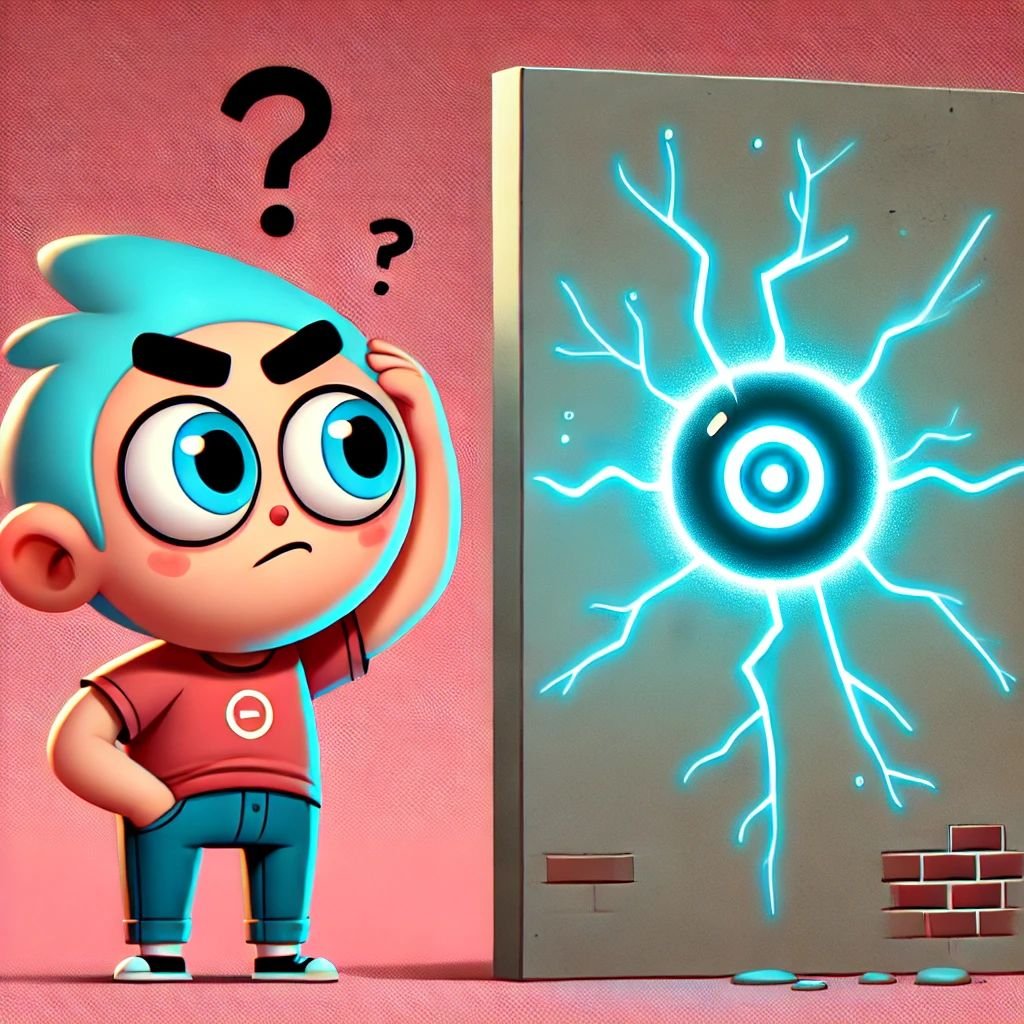
Imagine you’re standing in front of a locked door. Classical physics—the reliable kind that governs baseballs and planets—says you have to open the door to get through. There’s no other way. But if you were an electron, the rules would be… more forgiving. Instead of breaking the lock or squeezing through a crack, you might simply appear on the other side, as if the door was never there at all.
This isn’t magic. It’s not even defiance. It’s just probability. Electrons, like all quantum objects, aren’t tiny marbles rolling through space; they are smudges of existence, blurs of potential, waves of possibility. When one of these waves encounters a barrier—like a locked door—it doesn’t stop completely. Part of it seeps through, a whisper of its former self, and sometimes, against all expectation, the electron follows. Not by breaking the rules, but by obeying a deeper, stranger set of them.
It’s as if the universe itself misplaces the electron for a moment, un-trapped, allowing it to be somewhere new without ever crossing the forbidden space.
You’ve never seen this happen, not directly. But the world runs on it. Quantum tunneling powers the nuclear fusion in the sun, keeps semiconductors working, and whispers through the circuits of your phone. It’s why things don’t always stay where they should.
So the next time you flip a light switch, remember: the electricity that powers it moves, in part, because some particles forget they weren’t supposed to. Because somewhere in the dark, a shadow didn’t stay put.