
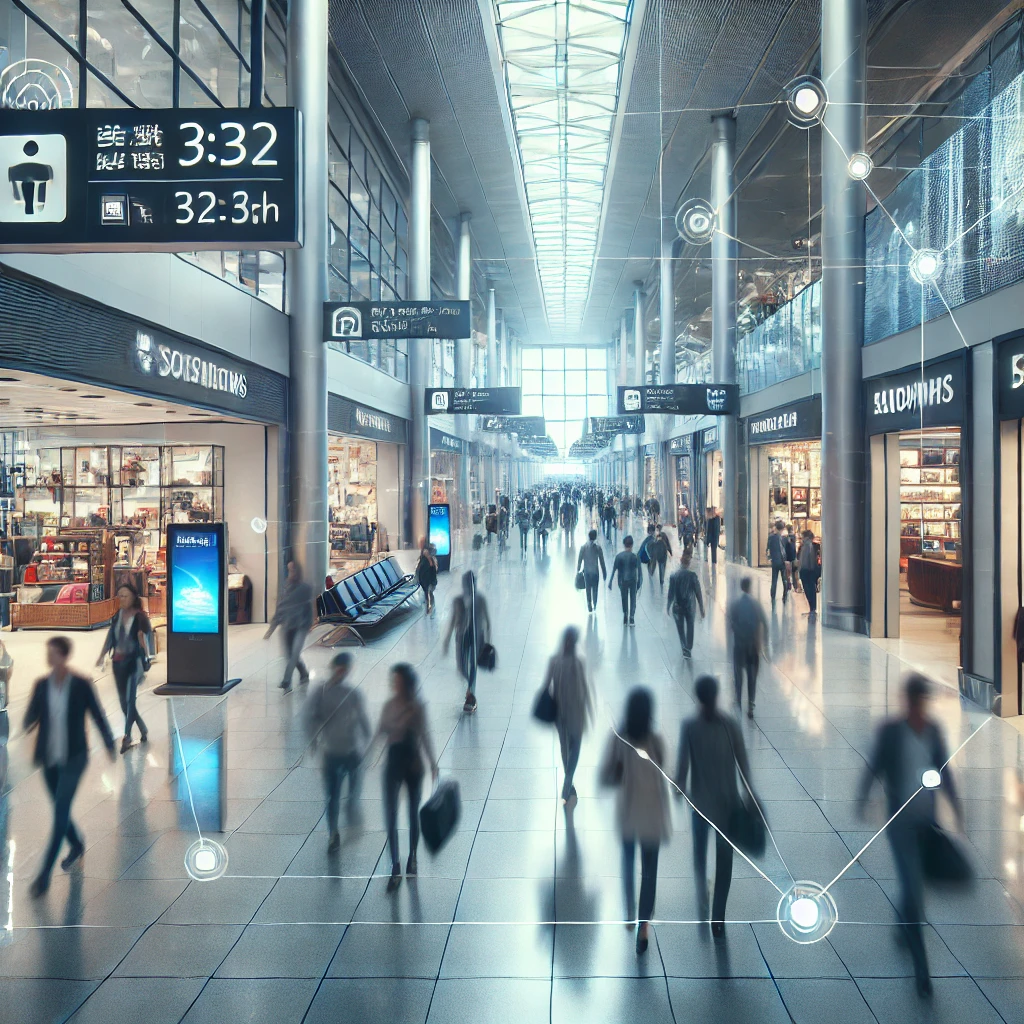
Somewhere between the perfume counters and pretzel carts, under the fluorescent hum of Terminal B, a quiet transaction unfolds—not of goods, but of gazes, footsteps, and lingering time.
We like to think we are the travelers, charting paths from gate to gate, destination to destination. But the airport, with its artfully delayed boarding times and maze of duty-free delights, tells another story. In this version, we are not the customer. We are the current—flowing predictably, tracked and modeled—powering a marketplace built not for us, but around us.
Passengers, as one quietly unsettling notion goes, are not the airport’s customer. We are the product: neatly packaged, counted, and sold to those who rent square footage inside the terminal. Merchants bid for proximity to our hunger, our boredom, our need for small comforts and impulse purchases. The true customers are those who pay to stand in our path.
It’s not just airports. The same dynamic hums quietly behind our morning scroll through social media, or the search for a quick recipe that turns into a scroll through ads, autoplay videos, and cookies clicking into place like tiny gears. We think we are browsing. But often, we are being browsed. Clicks and impressions become currency; our attention, harvested in fragments, becomes the raw material for someone else’s revenue stream.
This is the strange alchemy of the “free” internet: we are given tools, platforms, and entertainment at no monetary cost, but the exchange is far from costless. The toll is subtle—paid not in dollars, but in data, time, and the gentle reshaping of our choices. Algorithms learn us better than we know ourselves. And while we tap and swipe, something invisible tallies, predicts, and sells the outlines of our behavior.
It’s a quiet kind of displacement, this inversion of roles. We are not necessarily harmed by it, not in obvious ways. Many of these services do bring connection, joy, or utility. But the shift is worth noticing. When the thing seems free, it’s worth asking: who is paying? And what are they buying?
None of this is quite sinister. Or rather, not always. It is simply a system working as designed, shaped by incentives invisible to most of us, like gravitational fields guiding the orbits of moons. We drift through spaces—digital and physical—believing ourselves to be at the center, when we are more often satellites, moving through someone else’s model.
Still, there’s a strange comfort in naming it. In realizing that, sometimes, to step back is to see the edges of the frame. To know that in the economy of attention, there is no neutral ground—but there is always the chance to pause, to choose how we engage, or at least to wonder about the architecture behind our experience.
After all, even a product can wake up and ask: Who built this? And why do they want me here?
And in that asking, perhaps a different kind of freedom begins—not the absence of cost, but the presence of awareness. A flicker of agency, even in a terminal made to feel like a mall, even in a feed made to feel like home.